As you all may know either from Facebook, todays assembly, or through other resources, the Jena 6 situation has been dramatically downplayed by the media, similar to many other cases of discrimination. For those who are unaware of the Jena 6 situation (probably meaning you do not have a Facebook, you were not at assembly, or for any other reason) here is some background information:
In the small, rural Louisiana town of Jena in September 2006, a black student and some of their friends asked permission from school administrators to sit under the shade of a tree commonly reserved, by the white students, for the white students. School officials advised the black students to sit wherever they wanted and they did. The next day, three nooses, in the school colors, were hanging from the same tree. The Jena high school principal found that three white students were responsible and recommended expulsion. The superintendent of schools over-ruled the principal and gave the students a three day in-school suspension, saying that the nooses were “a youthful stunt” or "merely a prank." Black students decided to resist and organized a silent protest under the tree in disproval of the lenient treatment given to the noose-hanging white students. The principal reacted by bringing in the district attorney, Reed Walters, and 10 local police officers to an all-school assembly. The white students sat on one side of the hall and the black students on the other. It is reported that Walters told the students that he could "end their lives with a stoke of his pen." Many black students said he was looking at the them and only them. In November, as football season came to a close, the main school building was mysteriously burned to the ground. This traumatic event seemed to bring to the surface the boiling racial tensions in Jena.On a Friday night, Robert Bailey, a 17-year-old Black student and football player, was invited to a dance at a hall considered to be “white.” When he walked in, without warning he was punched in the face, beer bottles were thrown at him and a few white youths were found responsible. Only one of the white youth was arrested—he was ultimately given probation and asked to apologize.The night after that, a 22-year-old white man, along with two friends, pulled a shotgun on Bailey and two of his friends at a local gas station, in response to a scuttle between the two. The Black youths wrestled the gun from him to prevent him from using it. They took it home and hid it. They were arrested and charged with theft, and the man who owned the gun, however not with a perment, went free.The following Monday students returned to school. A white boy, Justin Barker, was taunting a group of black students, including Robert Baliey. He was verbally supporting the noose hanging. He was using racial slurs. A chaotic fray ensued. Barker was knocked down, punched, and kicked by a number of Black students. He was taken to the hospital for three hours. He had a concussion and minor bruising on his face. He was seen out at a social event later that evening.As a result of this incident, and their actions, six black Jena High School students were arrested and charged with attempted second degree murder. All six were expelled from school. The six charged were: 17-year-old Robert Bailey Junior whose bail was set at $138,000; 17-year-old Theo Shaw - bail $130,000; 18-year-old Carwin Jones--bail $100,000; 17-year-old Bryant Purvis--bail $70,000; 16 year old Mychal Bell, a sophomore in high school who was charged as an adult and for whom bail was set at $90,000; and a still unidentified minor.On the morning of the first trial, the District Attorney reduced the charges from attempted second degree murder to second degree aggravated battery and conspiracy. Aggravated battery in Louisiana law demands the attack be with a dangerous weapon. The prosecutor argued to the jury that the tennis shoes worn by Bell could be considered a dangerous weapon.When the pool of potential jurors was summoned, fifty people appeared, all white. The jury deliberated for less than three hours and found Mychal Bell guilty on the maximum possible charges of aggravated second degree battery and conspiracy. He faces up to a maximum of 22 years in prison.The rest of the Jena 6 await similar trials. Theodore Shaw is due to go on trial shortly. Mychal Bell is scheduled to be sentenced September 20th. Let's support him and the rest in order to help get them and others a fair and just sentencing for what they've done. Very few people have, even today, heard about this case. The trial was covered by the French newspaper Le Monde, and the BBC aired a documentary on the case. The London Observer reported on the Jena 6 story. These are the first that reported nationally and internationally. Since then many more have reported.
I recently, about two weeks ago, became aware of this issue and I was extremely appalled by it. Like Matty Grumbach said during the assembly (9/19), you would expect something like this in the days of the Civil Rights Movement but here it is, in 2007. This event brings us back to one of the course themes/ideas of "we" vs. "they" and the question "why do people discriminate?".
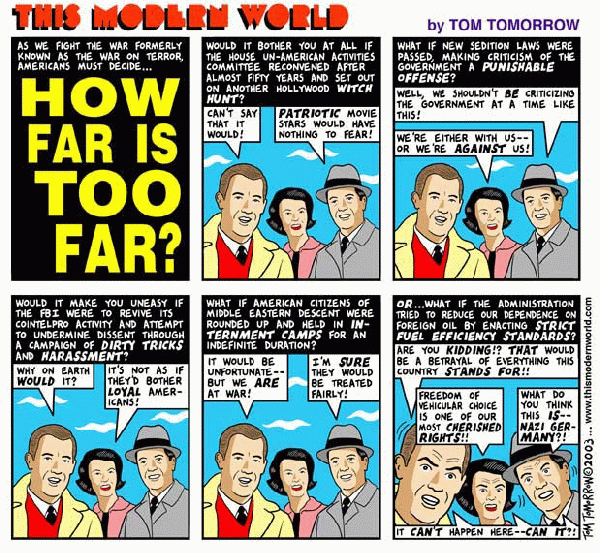
It worries me that if something at such a large scale like this is not even covered in the media (news, major headline in the newspaper, etc.) who knows how many issues have been hidden and/or ignored.
Questions to think about or respond to:
- Why do you think this issue has been so downplayed by the media?
- How do you think the situation should have been handled? Or do you feel the supervisor, court, etc. were just in their decision?
- If you felt threatened in some way, as the black high school students did, would you try to defend yourself? Would you handle it in the same manner? If not, what would you do? What if you were in their shoes?
- Many people are going to be wearing black tomorrow (Thursday) in protest of the courts previous decision and the upcoming decisions being made towards the 6 remaining students who have yet to be sentenced. Will you be wearing black as well? Why or why not? Do you think it will make a difference? [Any connections to Lemkin's argument???]
- What do you think can be a solution in fighting against discrimination?